

Turnover is up. Your managers seem stretched thin. Problems that should be handled one level down keep landing on your desk. Teams that used to work well together are siloed. Communication feels off.
You’ve done a gut check. You’ve had the conversations. And you still can’t quite put your finger on what changed.
Here’s what’s likely happening—and why it’s one of the most common new manager development challenges growing organizations face.
You Did Everything Right
Promoting from within makes sense. It rewards performance. It signals to your team that hard work leads somewhere. And it saves the time and cost of recruiting someone from the outside who doesn’t know your culture, your clients, or how you operate.
So you identified your strongest people—the ones who got results, earned respect, and understood the business—and you moved them into leadership roles.
On paper, that’s exactly what you’re supposed to do.
The problem isn’t the decision. It’s what happened next.

The Shift Nobody Prepares For
When someone steps into a leadership role, the entire nature of the job changes.
As an individual contributor, success is straightforward: produce results, solve problems, execute well. You’re measured on what you personally deliver.
In a leadership role, that changes completely. Now, success is measured by what your team delivers. Your job isn’t to do the work—it’s to build the people who do.
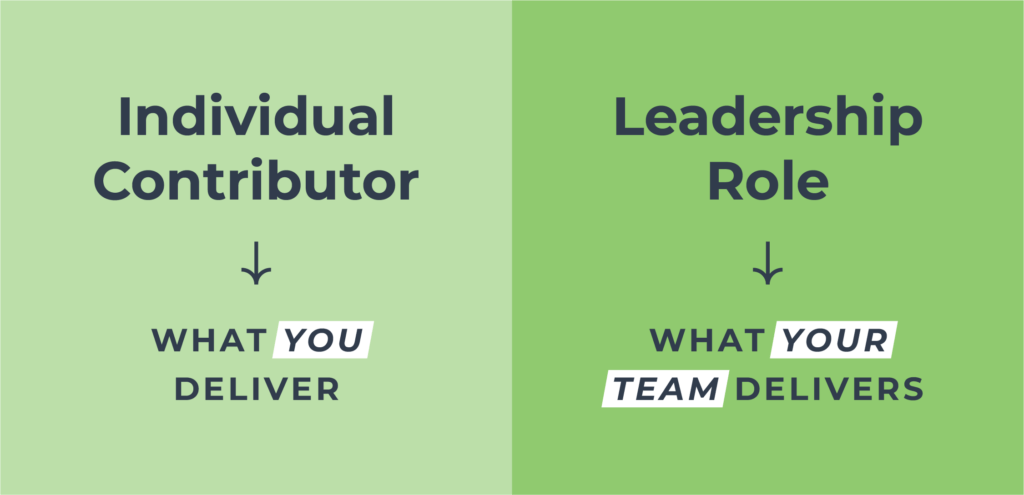
That sounds simple. In practice, it’s a completely different skill set. And it’s one that almost no one walks into a management role already having.
Most new managers were never trained for that transition. So they do the only thing that makes sense: they rely on the habits that made them successful before. They stay close to the work. They step in when something goes wrong. They avoid situations they don’t feel fully equipped to handle.
Those aren’t character flaws. They’re the habits that made them successful in the past. Now, they’ve turned into survival instincts.
Why the Old Habits Create New Problems
When a manager stays in “individual contributor mode,” the patterns are predictable:
They don’t delegate effectively. It feels faster to handle things themselves. But over time, they become the bottleneck, and their team stops growing because they never get the opportunity.
They avoid hard conversations. Feedback feels risky. They’re not sure how to approach it, especially when the relationship matters. So issues get addressed indirectly—or not at all—and performance problems linger.
Their time fills with the wrong things. Urgent tasks. Quick fixes. Problems they used to own. Instead of developing their people, thinking strategically, and leading—they’re buried in the day-to-day.
Sound familiar? If you’re seeing managers who are overwhelmed, teams that aren’t aligned, and performance that’s inconsistent across departments, this is likely what’s underneath it.
It’s not a people problem. It’s a development problem.
The Real Root Cause
Your managers aren’t failing because they’re the wrong people. They’re struggling because they were placed into roles that required a new skill set without the new manager development to match.
The three areas where this shows up most visibly, most often:
- Delegation: knowing what to own, what to hand off, and how to set clear expectations
- Feedback: approaching performance conversations with structure and confidence, not avoidance
- Time management: shifting focus from doing the work to developing the people who do it
These are learnable skills, and when managers are equipped with practical tools in these areas, the change in their teams is noticeable.
If you want to see what strong leadership looks like in each of these three areas and get three practical tools your managers can apply immediately, download The Promotion Paradox Playbook.
The Pattern Gets Expensive
Here’s what happens when this goes unaddressed.
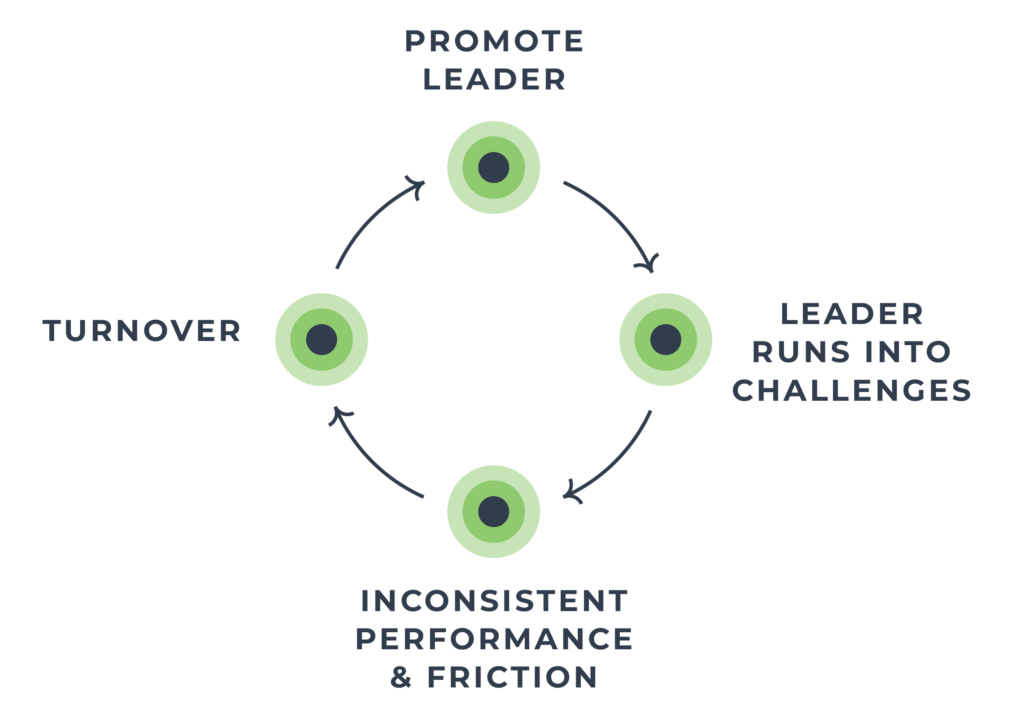
Strong individual contributors get promoted. They work hard and want to succeed. But they run into challenges they weren’t prepared for. Performance becomes inconsistent. Teams feel the friction. Turnover ticks up. And eventually, the conversation shifts to whether the person is right for the role.
Then the cycle repeats with the next promotion.
Stephens & Smith Construction, a Nebraska-based company, was in exactly this position. They were growing fast, promoting from within, and starting to feel the strain. Teams were siloed. Leaders were stretched. Opportunities were slipping.
Their managers weren’t the problem. The missing new manager development was.
After investing in intentional leadership development, the shift was significant—in alignment, in accountability, and in results. Revenue grew from $45M to $75M. The teams that used to operate in silos started winning together.
That’s not a coincidence. That’s what happens when you give your leaders the tools they need to actually lead.
Before You Can Fix It, You Need Clarity
Here’s the challenge with the promotion paradox: the symptoms are visible, but the gaps underneath aren’t always obvious.
You might know something is off, but not exactly where. Which managers are strong? Which ones are struggling, and in what specific areas? Where is your leadership layer costing you, and where is it working?
Without that visibility, it’s hard to know where to focus first.
The Leadership Pipeline Assessment gives you an objective view of your leadership team across 12 core competencies, so you stop guessing and start making targeted decisions.
What you get:
- A clear diagnostic across 12 leadership competencies
- A view of exactly where your team is strong and where it’s at risk
- Priority development strategies mapped to your specific gaps
- A free 30-minute debrief with a senior Leadership Resources advisor to walk through your results
No pitch. No pressure. Just clarity on where your organization stands and where to focus first.
What New Manager Development Actually Looks Like
Your managers are trying. Most of them genuinely want to lead well.
But wanting to lead and knowing how to lead are two different things. And the gap between them doesn’t close without intentional new manager development.
The good news: this is a solvable problem. It starts with knowing where the gaps actually are.