

Many organizations look to their top performers first when a management role opens. It feels like the obvious move, and often, it is. However, it’s not uncommon for the promotion to be followed by plateaued results, fractured teams, and burnt-out leaders. This disconnect is what we call the Promotion Paradox: the very skills that made someone exceptional as an individual contributor are not the skills that make them effective as a manager.
The good news: leadership is learnable. The following eight skills represent the highest-leverage investments a new manager, and the organization supporting them, can make in the critical first months of a management role.
1. Redefining Your Own Success Metrics
The most disorienting moment for new managers is discovering that the scoreboard has changed. The habits that earned the promotion (personal output, technical expertise, individual problem-solving) are now largely irrelevant to the job at hand. Managers who fail to redefine what success looks like for themselves are more likely to underperform long-term.
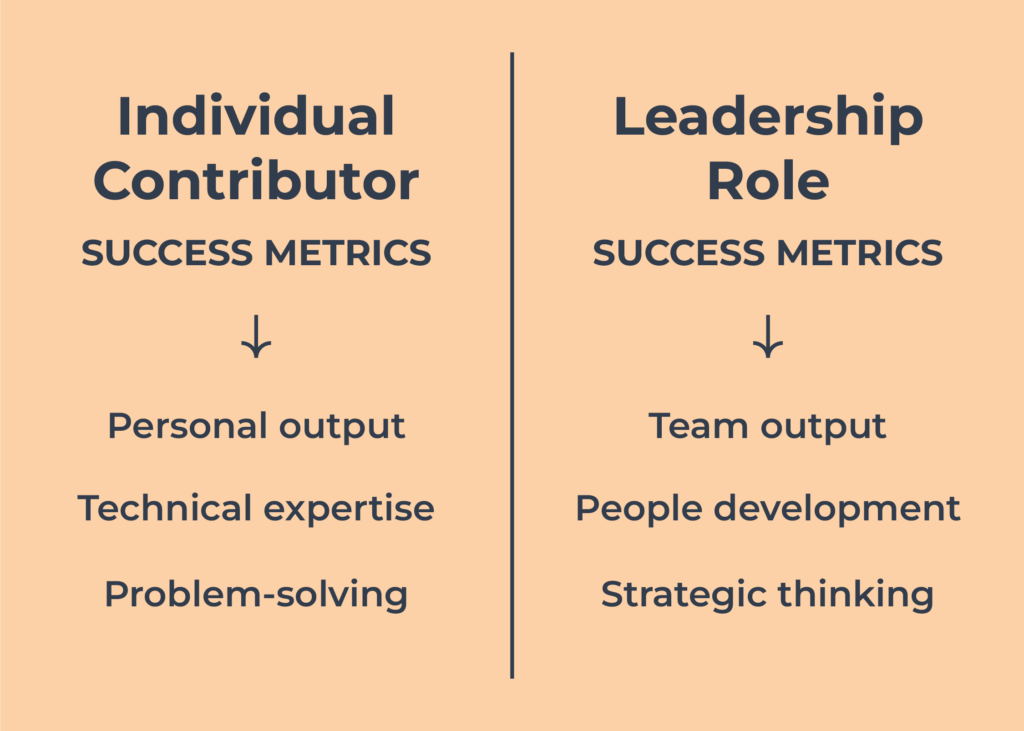
This transition can be a complete reorientation of how performance is measured, recognized, and felt on a daily basis.
For executives: Don’t assume new managers understand the new scorecard intuitively. Explicitly define what strong performance looks like in the role and resist rewarding them when they slip back into doing individual contributor work. If you celebrate the manager who “saved” the project by taking it over personally, you’ve just taught them the wrong lesson.
For new managers: Your instinct will be to help by doing. The more sustainable question is: How do I build a team that can handle this without me next time? Your job is now measured in other people’s growth and output. Learning to find satisfaction in that is a skill worth developing deliberately.
2. Delivering Feedback That Changes Behavior
Feedback is the core unit of managerial output. A manager who can’t deliver it clearly, consistently, and in a way that lands, will struggle to develop their team or address performance issues before they become expensive problems.
Studies show that employees want more feedback than they currently receive. Yet many new managers either avoid it entirely (to preserve relationships) or deliver it in ways that trigger defensiveness rather than change. Neither outcome serves anyone.
For executives: Build feedback into the management operating system. Regular 1-on-1 meetings, documented check-ins, and structured performance reviews give new managers a framework to work within rather than a blank page to improvise on. Without scaffolding structure, most people default to avoidance.
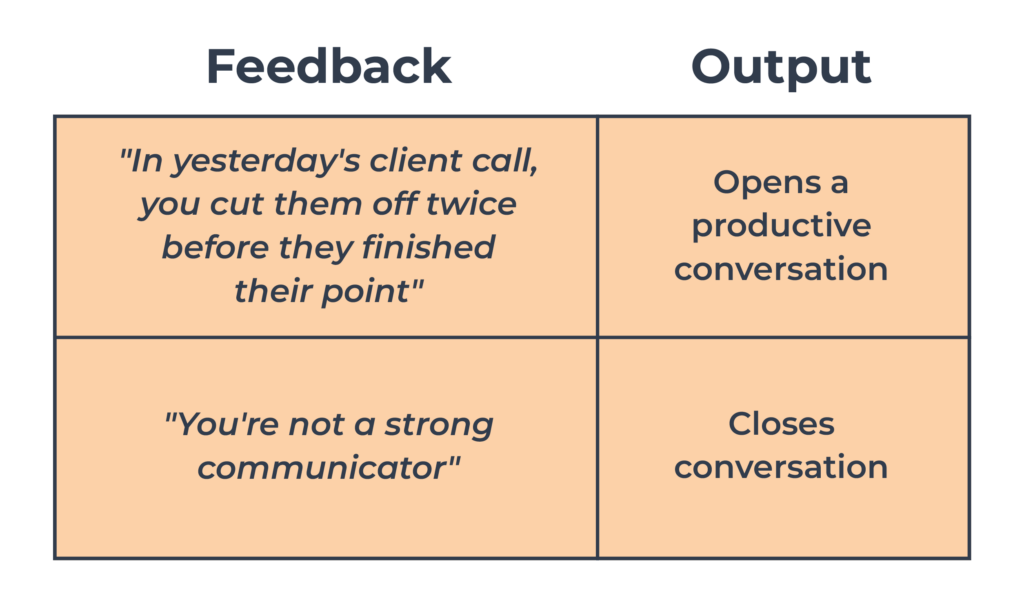
For new managers: The difference between feedback that changes behavior and feedback that creates resentment usually comes down to specificity. “In yesterday’s client call, you cut them off twice before they finished their point” opens a productive conversation. “You’re not a strong communicator” closes one. The former is about an observable moment; the latter is about identity. Aim for the former, every time.
3. Assigning Work Without Losing Accountability
Handing off work is easy. Handing off work in a way that keeps quality high, develops the person doing it, and doesn’t require constant rescue? Not so easy. New managers consistently underestimate how much of their early role is learning to assign work with the right level of context, autonomy, and follow-through.
The cost of getting this wrong runs in both directions. Over-controlling stifles the team and burns the manager out. Under-supporting leaves people stranded and produces work that has to be redone.
For executives: Create conditions where accountability for delegated work is shared, not entirely borne by the manager. If new managers fear being penalized when a team member stumbles, they will stop handing off meaningful work and your organizational throughput will quietly suffer for it.
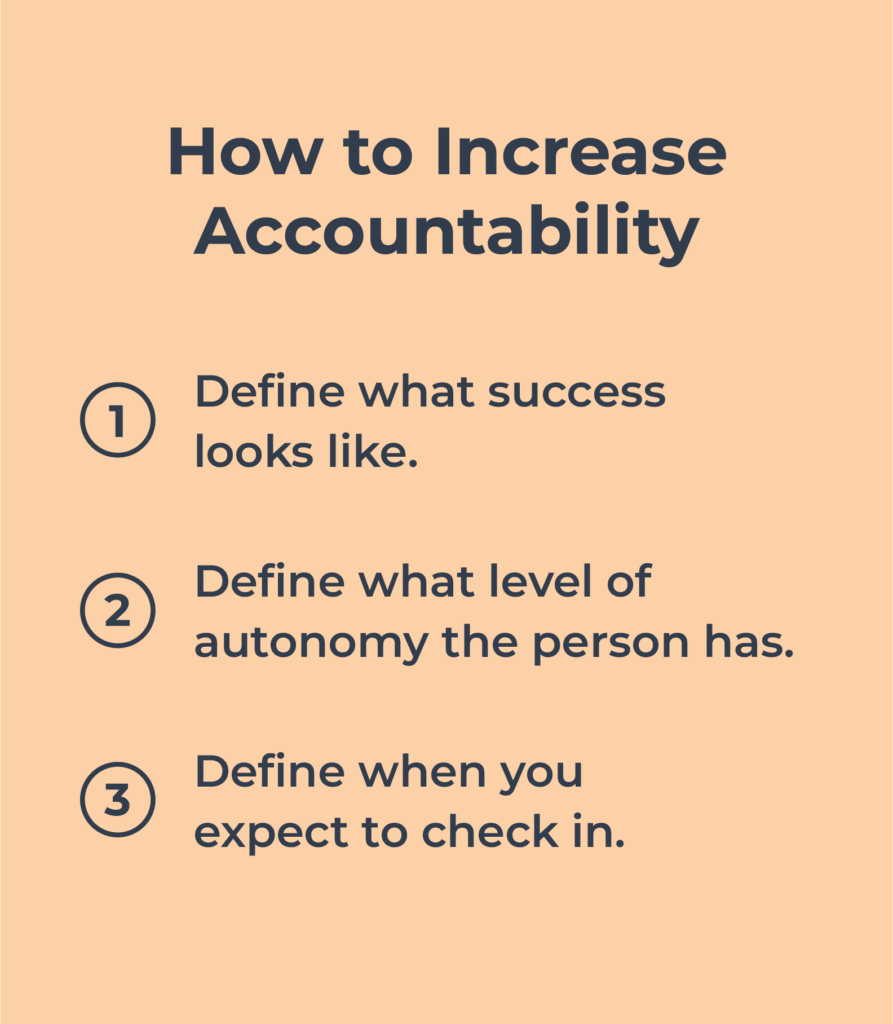
For new managers: Before you assign something, be clear on three things: what a successful outcome looks like, what level of autonomy the person has, and when you expect to check in. Getting specific makes autonomy actually work.
4. Conducting High-Value 1-on-1 Meetings
The weekly or biweekly 1-on-1 is the highest-leverage management tool available and the most frequently misused. When treated as status updates, they waste time that email could handle. When used intentionally, they build trust, surface problems before they escalate, and accelerate individual development in ways that nothing else quite replicates.
Employees who feel their manager genuinely cares about their development are more likely to be engaged. The 1-on-1 is where that perception is built… or lost.
For executives: Normalize and protect 1-on-1 time organizationally. When leaders routinely cancel them, the implicit message is that people are lower priority than tasks. New managers take their cues from what they see above them.
For new managers: Let your direct reports own the agenda at least half the time. Questions like What’s getting in your way? Where do you want to grow? What’s something I could do differently as your manager? generate more useful discussions than a project rundown. The goal isn’t to be informed. It’s to be useful to the person sitting across from you.
5. Addressing Problems Before They Become Patterns
Unaddressed issues don’t stay the same size. An interpersonal tension that isn’t named becomes a team norm. A performance gap that isn’t discussed directly becomes a new standard of behavior that other employees think is acceptable or it turns into a termination that surprises everyone.
New managers delay difficult conversations for understandable reasons: they want to be liked, they’re uncertain of their authority, or they simply don’t know how to start. But delay is rarely neutral. It almost always makes the eventual conversation harder.
For executives: Invest in giving new managers language and frameworks for hard conversations before they need them. Not after the first one has already gone sideways. Role-play scenarios are underutilized and highly effective at building this muscle in a low-stakes environment.
For new managers: The version of the conversation you have three weeks in is categorically easier than the one you have at six months. Early conversations are about a specific moment; late ones are about a pattern. And patterns are much harder to address without someone feeling ambushed or judged. Say the thing early, say it specifically, and say it with the relationship intact.
6. Making the Call When There’s No Right Answer
As an individual contributor, most decisions have a correct answer, a best practice, or at least a senior person to ask. As a manager, a significant portion of the job involves making calls with incomplete information, competing priorities, and no obvious playbook.
New managers often stall here. Waiting for certainty that won’t arrive, or escalating decisions that are appropriately theirs to own. Both patterns create drag on team momentum and signal to the team that their manager isn’t ready for the role.
For executives: Remove ambiguity around decision rights. New managers shouldn’t have to guess what they’re empowered to decide. A simple documented escalation framework (what’s mine, what requires input, what requires approval) eliminates a surprising amount of unnecessary hesitation.
For new managers: Develop the habit of deciding with what you have, documenting your reasoning briefly, and staying open to revising when new information arrives. A well-reasoned decision made on Tuesday almost always outperforms the same decision made perfectly on Friday. Speed and judgment compound over time; paralysis does too.
7. Creating a Team Where Problems Surface Early
Amy Edmondson’s landmark research at Harvard Business School identified psychological safety—the belief that team members can raise concerns, admit mistakes, and challenge ideas without fear of punishment—as the single strongest predictor of team performance. It outperforms talent density, resource access, and managerial experience.
New managers shape this environment constantly, usually without realizing it. A dismissive reaction to a question, a visible preference for certain voices in the room, or an unwillingness to admit their own uncertainty—any of these can quietly signal to a team that honesty carries risk.
For executives: The culture of psychological safety cannot be delegated downward if it doesn’t exist upward. If senior leaders penalize dissent or visible failure, new managers will inherit and replicate that dynamic regardless of what the training says.
For new managers: The fastest path to a team that tells you the truth is modeling it yourself. Admit when you don’t know something. Thank people for raising problems, even inconvenient ones. When something goes wrong, ask what can be learned before asking who is responsible. These behaviors, repeated consistently, build the environment where problems reach you early, when they’re still fixable.
8. Protecting Your Capacity Before It’s Gone
Management is additive in a way that catches most new managers off guard. Responsibilities expand—for their own work, for their team’s results, for upward relationships—with little corresponding reduction in what was there before. The result is a role that quietly exceeds sustainable capacity, often before the manager has developed the language to name it.
Burnout among new managers is not rare. The McKinsey Health Institute has found that managers experience the highest burnout rates, caught between strategic pressure and execution fatigue
For executives: Check in on your new managers as people, not just as channels for team output. Ask about their experience of the role. Build structures like peer cohorts, mentorship, access to coaching, that reduce the isolation that makes the early months of management unnecessarily hard.
For new managers: Sustainable performance starts with honest accounting of your capacity. Identify what depletes you and what restores you. Protect time for strategic thinking and recovery the same way you’d protect a client commitment. You cannot hold a team’s performance up from a depleted position, and running yourself into the ground in year one sets a precedent that is very hard to walk back.
The Bottom Line
The Promotion Paradox is not inevitable. Organizations that invest in equipping new managers (not just promoting them) see measurable returns in retention, engagement, and performance. And individuals who approach the transition with intention, rather than assuming competence transfers automatically, accelerate their effectiveness dramatically.
Leadership is not a reward for past performance. It is a new discipline that requires new skills, new habits, and ongoing development.
Ready for 3 free tools to help with delegation, feedback, and time management?