

Psychological safety as you know it is hurting your performance.
You’ve heard the term. You’ve probably even said it in a meeting: “We want to build a psychologically safe team.”
But here’s the question most leaders never stop to ask: what does psychological safety actually mean?
If you’re picturing a team where everyone’s comfortable, disagreements stay polite, and nobody ever leaves a meeting rattled… you’re not alone. But you are misunderstood.
Many leaders think the same thing. And it might be costing you your best performers.
The Myth We All Buy Into
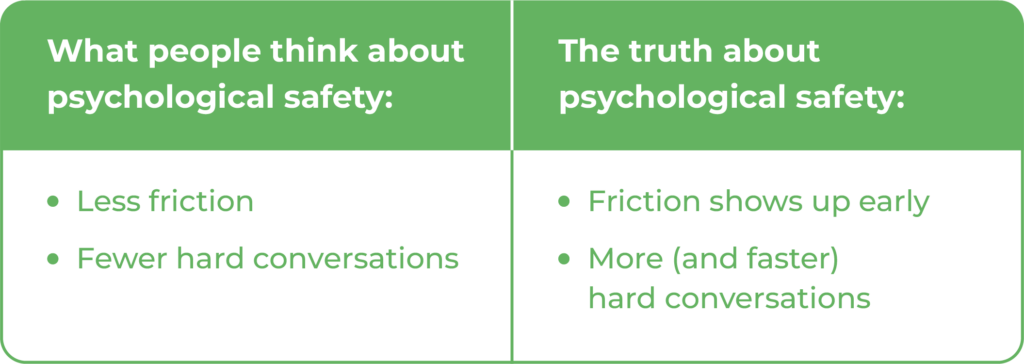
It’s an easy assumption to make. Psychological safety = playing it safe. Fewer hard conversations. Softer feedback. More wiggle room, because you don’t want anyone to feel uncomfortable.
Psychological safety is often seen as “nice culture stuff.” Something for the engagement survey, but not something that actually moves the needle.
That assumption isn’t just a little off. It’s backwards.
What Psychological Safety Actually Means
Psychological safety is not the absence of friction. It is the presence of trust.
Specifically: it is the belief that a person can speak up, take a risk, admit a mistake, or challenge an idea without getting punished or humiliated for it.
That’s the real definition. Not “nice.” Not “comfortable.” Just honest, without fear.
And here’s the part that surprises people: safe teams don’t have fewer hard conversations. They have more of them. Faster. Because nobody’s sitting on a problem, afraid to say it out loud. In teams with psychological safety, friction shows up early, while it’s still cheap to fix instead of three months later, when it becomes a crisis.
The Number That Should Get Your Attention
Feel free to skip the theory and go straight to the data, because it’s hard to argue with.
Wiley Workplace Intelligence surveyed 1,511 professionals and found that employees who strongly agree they feel safe speaking up, sharing ideas, or raising concerns are 31% more likely to be part of a high-performing team than those who don’t.
Read that again. This isn’t about comfort. It’s about performance.
That’s the piece most leaders miss. This isn’t a soft metric sitting off to the side of the real business. It’s one of the clearest predictors of it. Safe teams raise problems before they blow up. They challenge bad ideas before money gets spent on them. They ask for help before a small gap turns into a missed deadline.
Why This Stays Misunderstood
Three reasons this competency keeps getting missed, even by good leaders:
- It doesn’t show up on a dashboard. Revenue does. Attrition does. Trust and candor don’t have a line item, so it’s easy to underinvest in the very thing driving both.
- It gets confused with harmony. If you’re proud of your “positive culture,” disagreement can start to feel like a threat to it. In reality, safe disagreement is proof the culture is working, not a crack in it.
- It’s treated like the team’s job, not yours. You can’t build psychological safety with a poster in the break room. It’s built in real time in how you respond the very first time someone brings you bad news, owns a mistake, or pushes back on your decision. Blow those moments, and your team quietly recalibrates what’s actually safe to say to you.
So What Do You Actually Do About It?
The good news is, psychological safety is a fast skill to build once you actually see it clearly. Three shifts to start with:
Reward the flag, not just the fix.
When someone surfaces a problem early, even their own mistake, treat it like a win. What you reward is what you’ll keep getting.
Example: A team member comes to you and says, “I sent the client the wrong pricing sheet yesterday. I caught it, but I wanted you to know before they mention it.” Instead of jumping straight to “how did this happen,” you say, “Thanks for telling me right away, that’s exactly what I want to hear about.” You deal with the mistake, sure. But you deal with it after you’ve made it clear that flagging it was the right move. Next time something’s off, they come to you in hours, not weeks.
Attack the idea, protect the person.
Push back on ideas as hard as you need to. Just don’t let it bleed onto the person who raised them. Teams learn that difference fast, and it shapes what they’re willing to say out loud next time.
Example: Someone pitches a plan in a meeting and you think it’s genuinely weak. You can say, “I don’t think this plan accounts for the budget cuts. Walk me through how it holds up if we lose 20%,” instead of “This doesn’t make sense, did you think this through?” Same level of pushback. Completely different message about whether it’s safe to pitch the next idea.
Go first.
If you never admit uncertainty or own a mistake, you’ve just set the ceiling for what your team will admit either. Safety doesn’t trickle up. It flows down from you.[TO1]
Example: Before asking your team to own their mistakes, you own one of yours out loud. In a real meeting, not a private aside. “I pushed us toward that vendor too fast last quarter, and it cost us. I should’ve slowed down and gotten more input.” You don’t need to overdo it or self-flagellate. Just make it visible that admitting a miss doesn’t end your credibility. It usually builds it.
Your Move
Psychological safety is never about running a gentler team. It’s about running a more honest one. And honesty, it turns out, is a performance strategy, not a personality trait.
So here’s the real question, and it’s not whether your team seems comfortable:
Do they feel safe enough to tell you the truth?
Take the First Step
Want to do a little more digging into your teams’ leadership competencies? Take our FREE Leadership Pipeline Assessment and measure your team’s psychological safety along with 12 other leadership competencies.