

Why Team Health Matters
One thing we’ve learned after working with so many organizations is this: Your team’s health will make or break your long-term success.
The truth is you can feel it instantly. Healthy teams move with clarity. They communicate. They trust each other. They solve problems quickly. Unhealthy teams? Everything takes longer, people avoid tough conversations, priorities get blurry, performance declines and culture can take a hit.
Companies with stronger organizational health consistently outperform their peers. This insight is supported by Gallup’s State of the Global Workplace research.
Not because they’re perfect, but because they’re aligned. Strategically, operationally, and culturally. Alignment in these 3 areas first starts with visibility.
That’s why the team health assessment is vital.
What the Team Health Assessment Is
Our Team Health Assessment is simple: It’s a snapshot of how well a team is working together
It looks at five core areas that make a team strong:
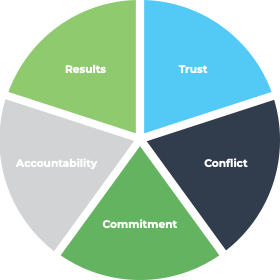
- Trust
- Conflict (Healthy)
- Commitment
- Accountability
- Results
These aren’t buzzwords, they’re the foundation of high performance.
The assessment gives companies an unfiltered look at how their team is doing. It gives them an opportunity to talk about what’s really happening beneath the surface.
Why We Took It Ourselves
We ask our clients to be open, honest, and self-aware, so the same should be expected from us.
Like all companies, we’re in a constant state of growth and evolution. So we put our own framework to work and walked through the same process we coach other companies through.
What It Was Like for Our Team
Even though this is our world, taking the assessment made us feel vulnerable. With a mix of excitement and unease, we dove in, forcing ourselves to think deeply:
- Are we intentionally building trust?
- Are we having healthy, productive conflict?
- Are we communicating expectations clearly?
- Are we holding each other accountable?
- Are we aligned on what results truly matter?
And what we saw reminded us: We’re human, we have blind spots like every team and organization
That’s why looking in the mirror matters.
Reviewing the Results Together
When we brought the results into our all-company meeting, talking openly about the results, it allowed us to communicate authentically and started the procession of strengthening and unifying us.
There’s something powerful about putting everything on the table and choosing to grow from it together.
What We Did Next
We brought our results into an all-company meeting and committed to reviewing them openly. Rather than glossing over the numbers, we spent time discussing the areas where scores came back below average and what those scores might be telling us.
Two prompts, in particular, stood out:
- Once a decision is made, we take action.
- We apply our own best practices with discipline in the organization.
We encourage our clients to not think of below-average scores as alarming but revealing.
These scores pointed to a breakdown between decision-making and execution. Something that could have easily gone unnoticed without the assessment.
These two prompts became our focus areas.
How It Continues to Make Us Better
Results and insights mean nothing without action.
Rather than treating the assessment as a one-time exercise, we used it as a starting point. We built a focused plan aimed specifically at improving the two lowest-scoring prompts.
Take this statement, for example: Once a decision is made, we take action.
To better understand the impact of this score, we asked the team what it felt like in practice. The feedback was consistent. When decisions didn’t visibly translate into action, it led to:
- Reduced buy-in
- Uncertainty around company priorities
- A lack of clarity on individual goals
This is a clear example of how the Team Health Assessment surfaces alignment issues that often exist beneath the surface but directly affect culture, performance, and engagement.
To address this, we implemented a simple but intentional change: Communicating key decisions more clearly and consistently, including the why behind them
While this shift may seem small, it’s had a meaningful impact. By improving how decisions are communicated and reinforced, the team now feels more connected to the direction of the organization and more invested in the outcomes.
This is how low scores should be handled. Not as failures, but as signals.
Awareness is the first step to alignment. When gaps are made visible and addressed together, everyone knows where the organization is headed and how they contribute to getting there.
Closing Thoughts
If there’s anything this experience reinforced, it’s this: Healthy teams aren’t lucky, they’re intentional.
Taking our own Team Health Assessment grounded us, aligned us, and pushed us forward in the best possible way.
Ready to see what investing in team health unlocks for your organization?
Talk with a Leadership Resources representative about your goals, challenges, and next steps.
Grant Thornton & Oxford Economics. Return on Culture: Proving the Connection Between Culture and Performance.
Gallup. State of the Global Workplace and Q¹² Meta-Analysis.